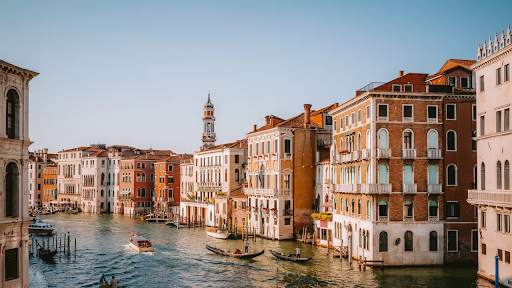
Venice has no cars in its historic center, which makes the question sound like it should have an easy yes. It mostly does. The city is built for feet, not wheels, and most of what draws people there, the narrow calli, the small campi, the churches tucked behind laundry lines, only really works at walking speed. What the question misses is the other half. There are moments a bridge just isn’t there, and that’s where a gondola stops being a photo op and starts being the fastest way across. Browsing gondola routes on Alle! before a trip is a decent way to see where those gaps actually are, before you’re standing at a dead-end calle wondering why the map lied to you.
Where walking wins
Most of central Venice rewards getting lost on purpose. The sestieri of Dorsoduro and Cannaregio are dense with pedestrian routes that loop past squares no tour group stops at, and nothing about that experience improves by being on the water instead. I’ve spent whole afternoons just following whichever alley looked less crowded, and more than once that turned into the best part of the day. Walking also costs nothing beyond time, which matters on a multi-day trip where gondola rides add up fast.
Where the bridges run out
Venice has more than 400 bridges, but they weren’t laid out for tourist convenience — they follow centuries-old property lines and canal widths that predate any modern city planner. That means two points a hundred meters apart by water can be a fifteen-minute walk by land, looping around a canal that has no crossing nearby. This is the actual case for a gondola or a traghetto: not romance, but geometry. Locals use the cheap traghetto crossings for exactly this reason, standing up in a shared gondola for the length of the Grand Canal because it’s genuinely quicker than walking to the nearest bridge and back.
Only About 400 Gondoliers Are Licensed to Work
The price tag makes gondolas easy to write off as a tourist markup on a boat ride. The job itself argues otherwise. Venice currently has roughly 400 licensed gondoliers, down from an estimated 10,000 gondolas working the canals in the 1500s. Getting the license takes about 400 hours of training over six months, plus an exam covering city history, navigation, and languages. Licenses rarely go to outsiders, since spots tend to pass within families who have worked the canals for generations. That kind of barrier to entry is closer to a licensed profession than a novelty ride, which is part of why the price doesn’t move much no matter which company sells the ticket.
A one-day plan that actually uses both
Walk the morning. Save the water for the afternoon, when the light on the Grand Canal is better anyway and your feet have earned a sit-down. A shared gondola crossing near Rialto covers the geometry problem for a few euros. A longer private ride is worth it only if the quiet matters more than the price, since a shared boat with four strangers on board isn’t exactly a contemplative ride. I’ve never managed more than one ride a day without the two starting to blur together, so there’s little reason to overbook the water part of the trip.
The honest downside is the price. Gondola rates are fixed across operators, and no amount of walking gets you the view from the water, so budget for at least one ride even if the plan is to walk everywhere else. Venice rewards the walk most of the time. It just doesn’t apologize for the days it doesn’t.